
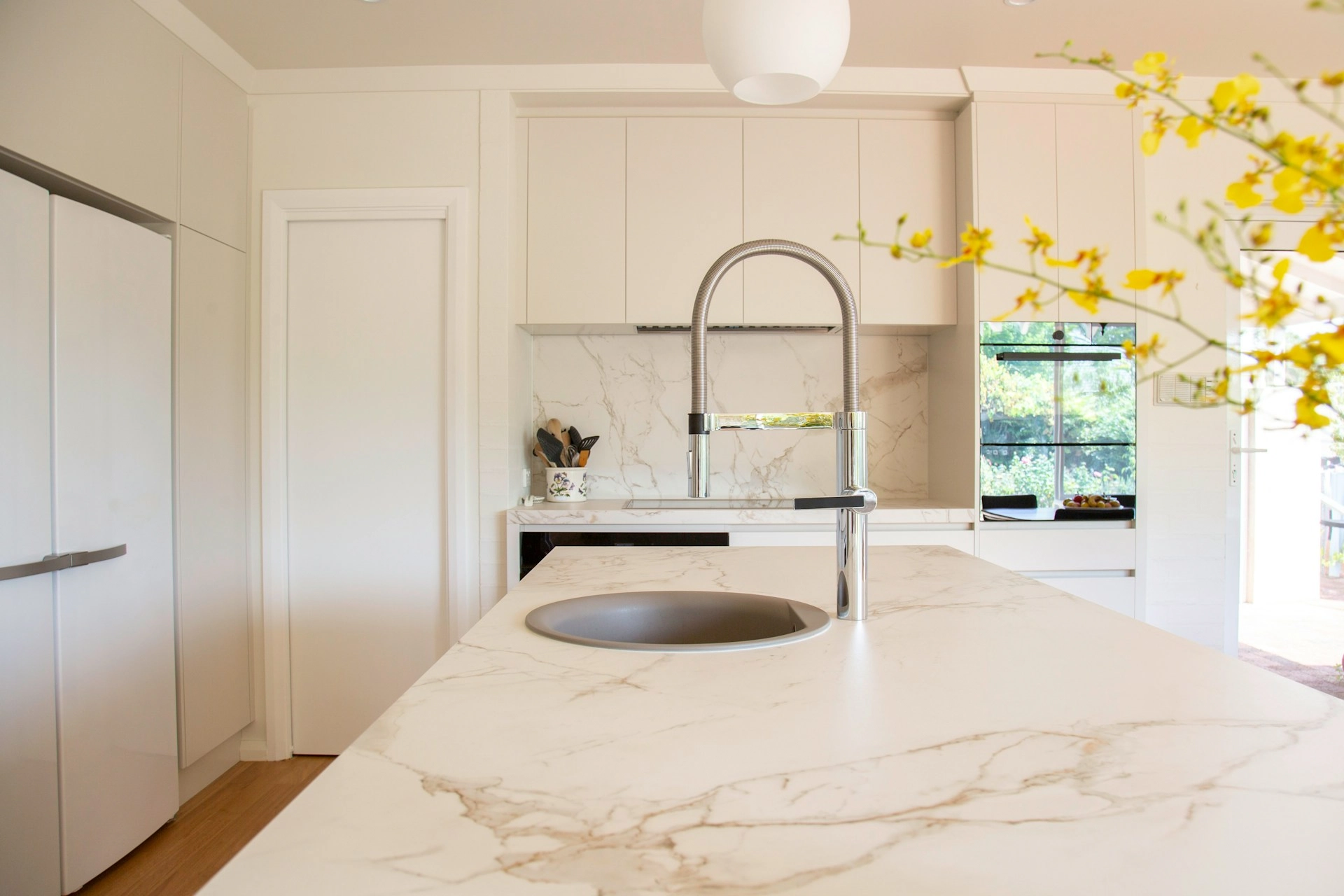
Most Singapore homeowners spend a lot of time choosing their kitchen tiles and almost no time thinking about kitchen countertops — until the contractor asks and they realise they have no idea what the difference between sintered stone and quartz actually means. Then it becomes a rushed decision made in a showroom under mild pressure, which is roughly the worst possible way to choose something you’ll touch every single day for the next decade.
This is the guide we wish more homeowners read before that conversation. It covers the main countertop materials available for Singapore kitchens, how they hold up in real daily use, and what they cost. From the team at RS Carpentry, who specify kitchen countertops for HDB, BTO and condo renovation projects every week.
The Singapore Kitchen Is Hard on Countertops
Before the materials, a reality check. Singapore kitchens get used hard. High heat from wok cooking, oil splashes from daily stir-frying, the acid from tamarind and lime juice, and the cleaning chemicals that follow. Many countertop materials that look beautiful in European showrooms perform poorly here because they were designed for gentler kitchen habits. Material choice has to account for actual Singapore cooking, not aspirational light-use kitchen aesthetics.
Sintered Stone
Sintered stone — sold under brand names like Dekton, Neolith and Lapitec — is the premium countertop choice in Singapore renovation right now, and the performance justifies the price premium for heavy cooking households.
Made by compressing and heating natural minerals under extreme pressure, sintered stone is essentially indestructible under normal kitchen use. Hot wok straight off the stove — no problem. Tamarind curry left overnight — wipes clean. Sharp knife slipped sideways — barely a mark. It’s non-porous, so it doesn’t absorb oils or stains, and it doesn’t need sealing.
The main downsides are cost and weight. At S$120–S$220 per running foot installed, it’s significantly more expensive than quartz. And it’s heavy — the cabinet carcass needs to be well-built to carry it. This is why the carcass spec matters as much as the countertop spec; see our guide on kitchen cabinet materials and cost for the full breakdown.
Quartz (Engineered Stone)
Quartz countertops are made from crushed natural quartz bound with resin. Brands like Silestone, Caesarstone and local suppliers like Stone Amperor are the names you’ll see most often in Singapore showrooms.
Quartz is non-porous, hard-wearing, and comes in an enormous range of colours and patterns — including convincing marble looks. It handles most kitchen abuse well. The vulnerability is heat: resin binders soften under sustained high heat, so you shouldn’t put a scalding wok directly on quartz without a trivet. For households that frequently cook with woks at full flame, sintered stone is the safer choice. For households that cook light meals a few times a week, quartz is excellent value at S$90–S$150 per running foot installed.
Marble
Marble is the material everyone wants until they find out what it actually involves in Singapore. It’s porous, which means tamarind stains. It’s soft, which means knife marks. It requires sealing every 12–18 months or the staining becomes permanent. And it’s reactive to acidic food — lime juice, vinegar, even certain cleaning sprays etch the surface over time.
We do install marble countertops, but usually only in bathrooms where the acid and oil exposure is lower, or in dry kitchen areas. For wet kitchens — where the bulk of Singapore cooking happens — marble is a beautiful choice that most homeowners regret within two years.
Granite
Natural granite is harder than marble, more heat-resistant, and slightly less fussy about maintenance. It does need sealing periodically, and the colour options are more limited than engineered stone. Cost-wise it sits between quartz and sintered stone. It’s a solid, unfussy choice for homeowners who want natural stone without marble’s maintenance demands — though quartz now covers most of the same ground at similar or lower cost with more consistent patterning.
Solid Surface (Corian-type)
Solid surface is a resin-based material sold under brand names like Corian, HI-MACS and Staron. Its main advantage is seamless fabrication — no visible joins at corners or around the sink, which eliminates the grout lines where bacteria can accumulate. Minor scratches can be sanded out on-site, which is genuinely useful.
It’s softer than stone, so it scratches and marks more easily. And it’s heat-sensitive — similar to quartz, wok heat is a problem. Common in commercial kitchens and bathrooms in Singapore. For residential wet kitchens, it’s a mid-range option that works well if cooking intensity is moderate.
Laminate (HPL)
Laminate countertops have a reputation problem they don’t entirely deserve. Quality HPL (high-pressure laminate) from brands like Admira or Formica is genuinely durable, easy to clean, available in hundreds of finishes including convincing stone looks, and significantly more affordable than engineered or natural stone. At S$40–S$90 per running foot installed, it’s the lowest-cost option that still works.
The vulnerability is moisture at the edges. If the edge banding lifts — usually from a repeatedly wet spot near the sink — moisture gets in and the substrate swells. Edge sealing and quality installation matter. This isn’t a reason to avoid HPL; it’s a reason to make sure it’s installed correctly with properly sealed edges and no thin, poorly-bonded trim.
The Countertop Cost Comparison (Singapore, 2026)
Installed prices per running foot, based on current market rates:
- HPL laminate: S$40–S$90
- Quartz / engineered stone: S$90–S$150
- Solid surface: S$100–S$160
- Granite: S$110–S$180
- Sintered stone: S$120–S$220
- Marble: S$150–S$300+ depending on grade
For a typical L-shape HDB kitchen with 12 running feet of counter, the difference between HPL and sintered stone is roughly S$1,500 to S$2,500 on the countertop alone. Worth it for a serious cooking household. Harder to justify if the kitchen sees one home-cooked meal a week.
Coordinating the Countertop With the Rest of the Kitchen
The countertop material should flow from the overall kitchen style, not contradict it. Marble on Japandi cabinets works. Sintered concrete on industrial-style kitchen joinery works. Glossy white quartz on a Scandinavian-style kitchen works. But marble paired with matte charcoal laminate cabinets in a contemporary kitchen usually creates visual conflict — the warm, organic veining fights the cool, restrained palette.
For style-by-style guidance, our articles on Japandi interior design, modern contemporary design and Scandinavian design for Singapore homes all touch on countertop material choices as part of the broader kitchen palette. Lighting tone matters just as much — the same sintered stone reads very differently under 3000K versus 6000K, as we cover in our guide on why light tone matters in interior design.
Get an Honest Kitchen Countertop Quote
Countertop pricing changes with slab availability, thickness and edge profile — so real numbers require a real measurement. Contact RS Carpentry for a free site visit and a kitchen quotation that breaks out countertop material and installation separately from cabinet cost, so you can see exactly where your budget is going. You can also browse our completed kitchen renovation projects to see how different countertop materials look in real Singapore homes.


